


Hey Hulk, Are You Cheating? How to Animate a Believable Jump


Hulk. 8 feet of green muscle, a terrible temper, and an unfortunate habit of crossing the landscape in three bounds.
In Ang Lee's Hulk (2003), there's this iconic scene: Hulk runs, then chains together gigantic leaps, dozens of meters high.
Now, look closely at how he takes off. He runs... and boom, he's airborne. Then look at his trajectory in flight. Something bugging you? That's normal.
So, Hulk... are you cheating?

To answer that, you need to understand one thing: energy doesn't come out of nowhere. You have to go get it, store it, then release it at the right moment. That's as true for Hulk as it is for your character. A jump that feels weak, a character who takes off from nowhere, who floats in the air: most of the time, that's where the problem comes from.
Here's what this article covers:
What is energy for an animator?
The jump: crouch deeper or get a running start?
Hulk, up to the board!
What this changes in your animation
1 - What is energy for an animator?
Don't panic, we're not going to redo your high school physics class. Just remember this:
Energy is never created, it's transformed.
For us animators, three forms are enough:
Height energy (potential): the higher an object is, the more energy it has in reserve. A ball sitting on the edge of a roof is "waiting" to fall.
Speed energy (kinetic): the faster an object goes, the more it has. It's the one that hurts when you walk into a door.
Elastic energy: a compressed spring, a drawn bow, a stretched rubber band... or a stretched muscle or tendon.
A movement is a series of transformations between these three forms. And the jump is the perfect example:
Anticipation: the legs bend, the tendons stretch (elastic energy)
Push-off: the character accelerates (speed energy)
Rise: they slow down as they gain height (speed becomes height)
Fall: they speed up as they lose height (height becomes speed again)
Landing: the legs bend to absorb all that energy
If even one of these steps is sloppy, the jump feels wrong.
2 - The jump: crouch deeper or get a running start?
Speed has a direction
Energy tells us how high a character can go. But it doesn't tell us which direction they'll go. For that, we need another, very simple idea:
Speed is an arrow.
An arrow has a length (how fast you're going) and a direction (where you're going). And any arrow can be split into two pieces: a horizontal piece and a vertical piece.

A ball rolling forward has a big horizontal arrow and no vertical arrow. A falling ball is the opposite.
A force is a push
In physics, a force is an action that pushes or pulls an object in a specific direction. Your foot kicking a ball, the ground pushing you back up when you jump, the Earth pulling everything toward it: those are all forces.
And a force does only one thing: it changes the speed arrow. It can make it longer (the object speeds up), shorter (it slows down), or tilt it (it turns). And the arrow always tilts toward the side you're pushing.
Which brings us to the most important idea in this whole article:
Without a force, the speed arrow never changes. A moving object keeps going straight, at the same speed. It doesn't stop on its own.
That sounds strange, because on Earth, everything eventually stops. But that's only because there's always something slowing it down.
In space, far from any planet, there's almost nothing left to slow things down. Throw a ball out there: it will fly in a straight line, at the same speed, forever. That's exactly what the Voyager probes are doing: launched in 1977, with no engine pushing them, they keep moving away from the Sun at more than 50,000 km/h (over 30,000 mph).
On Earth, one force is always at work: gravity. It pulls down, and only down. So it can only change the vertical part of the arrow: that's what brings back down everything that goes up.
The horizontal part, it leaves alone. As long as there's no obstacle (a wall) and no resistance (friction from the ground or the air), a thrown object keeps going straight horizontally, at the same speed.
The rooftop ball experiment
Imagine you're on the roof of a 6-story building, 20 m (about 65 ft) high, with three balls.
The first one, you just drop.
The second one, you kick gently, perfectly horizontal.
The third one, you kick as hard as you can, still horizontal.
Which one hits the ground first?
Answer: all three at the same time. After about 2 seconds. The dropped ball lands at the foot of the building, the gently kicked one lands 10 m away, the hard-kicked one 40 m away. But they hit the ground at the exact same moment.
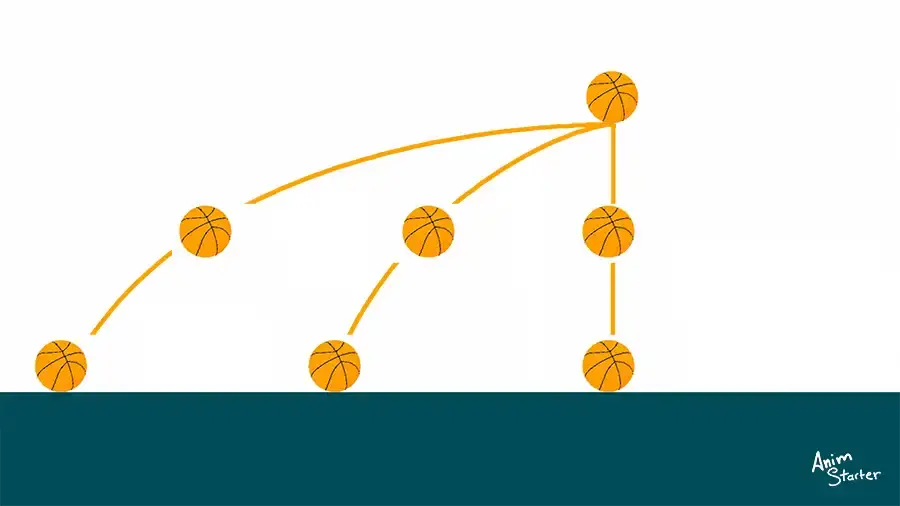
Why? Because gravity only pulls down. It couldn't care less about the horizontal arrow. All three balls start with the same vertical arrow (zero), so they fall in exactly the same way. The only difference is how far they travel horizontally during that fall.
First golden rule:
What happens horizontally doesn't change anything vertically.
(Note for the curious: this is true if the ball leaves perfectly horizontal. If you kick it slightly upward, it stays in the air longer.)
During the flight: the parabola
Open the graph editor on the main controller of a jump. Translate X and Translate Y are two separate curves. Exactly like in the ball experiment.
Once the feet leave the ground:
Translate X (horizontal) is a straight line. Nothing pushes or slows the character horizontally, so their speed doesn't change. Even spacing from frame to frame.
Translate Y (vertical) is a bell curve. Gravity slows the rise, then speeds up the fall. Flat tangents at the top, tight spacing at the apex, wide spacing near the ground.
Put together, these two curves draw a parabola.
Second golden rule:
In the air, everything that goes up slows down, everything that comes down speeds up. And nothing else changes.
(To be completely accurate: after a while, air resistance prevents any further acceleration. A skydiver in free fall tops out around 200 km/h (about 120 mph), after a dozen seconds of falling. But for a ball dropping 10 meters, or a character's jump, the fall is far too short for it to show. Even for our Hulk, heavy and compact, the air changes almost nothing over a few dozen meters.)
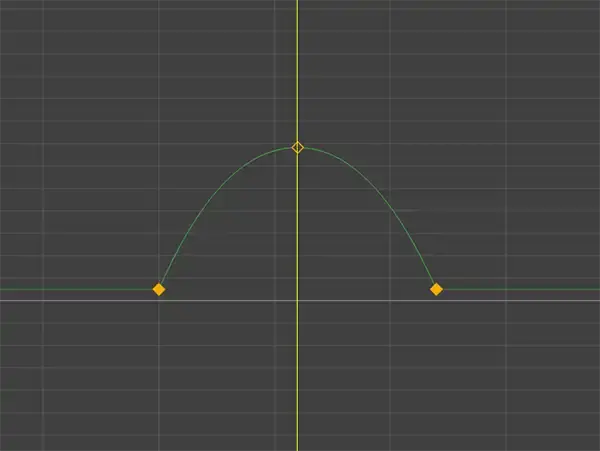
To check your jump, turn on a motion trail on your hips controller (or a locator constrained to the COG). If the trail isn't a nice symmetrical arc, something's off. Your character can flail around as much as they want in the air: their arms and legs move around this parabola, not instead of it.
To change the arrow's direction, you need another arrow
A speed arrow never changes on its own. To turn it, lengthen it, or shorten it, a force has to push on it. A force is also an arrow.
In the air, there's only one force: gravity, pointing down. It can only affect the vertical arrow. That's why the character can't change their trajectory once they've taken off.
On the ground, there's a second force: the ground pushing back. When your character pushes against the ground with their legs, the ground pushes back. It's the only way to create a vertical arrow.
So to go high, only one question matters: how do you get a big vertical arrow at takeoff? There are two main ways to do it.
Solution 1: crouch and push
Try jumping with your legs straight, without bending your knees. You lift off by... a few millimeters. Makes sense: the ground can only push you while your feet are in contact and your legs are extending. With straight legs, there's nothing left to extend.
When you crouch, you give yourself a runway. The longer that runway, the longer the ground pushes you, the more your COG accelerates upward, and the bigger your vertical arrow at takeoff.
In animation, this is called anticipation: the character gathers energy before spending it.
Remember the center of gravity? That's what you need to track. During the crouch, the COG goes down. During the push-off, it rises while accelerating. Once in the air, the parabola is set.
Third golden rule:
The height of the jump is decided on the ground. It has to read in the anticipation.
The magic formula (I promise, it's the only one). During the push-off, the legs have to provide all of the jump's energy. And that energy is the push force multiplied by the distance you push over. Hence:
Push force = weight × (1 + jump height ÷ push depth)
Example with you: you jump 50 cm, pushing over 40 cm. Your legs need to push about 2.25 times your body weight. That's realistic: a good jumper pushes around 2 to 3 times their weight. And if the push depth approaches zero (straight legs), the required force becomes infinite. Keep that in mind for Hulk.
And two nuances that matter in animation:
Lower isn't always better. Leg muscles are less efficient when the knees are deeply bent, and going very low takes time. An exaggerated crouch reads as a character straining, not as a powerful character (except in cartoony animation, where that's often the desired effect).
The bounce helps. If the character drops quickly and comes right back up, their tendons store elastic energy, like a spring, and give it back during the push-off. A long "hold" in the low position is a readability choice, not a physics one.
Finally, the arms. Swung upward during the push-off, they add speed to the whole body. Try jumping onto a box: you'll notice your arms help you!
Solution 2: get a running start... and turn the arrow
A long jumper never starts from a standstill. Their run-up gives them a huge horizontal arrow. But remember the ball experiment: a horizontal arrow doesn't rise on its own. If the jumper just keeps running, they keep running.
To turn some of that speed into height, you have to turn the arrow upward. And to turn it, you need another force: the ground has to push them upward.
That's the whole job of the last steps:
On the second-to-last step, the jumper lowers their COG. It's a small anticipation in the middle of the run.
On the last step, they plant their foot in front of them. Their body vaults over that leg, and the ground pushes them upward throughout that pivot.
The price to pay: at takeoff, the jumper loses some horizontal speed. Makes sense, part of their arrow has turned vertical.
The other way to turn the arrow: the ramp. A skater, a skier, or a BMX rider doesn't need to bend their legs to take off: the ramp does it for them. It pushes on the character perpendicular to its surface and turns their arrow upward.
But careful: a ramp turns the arrow, it doesn't lengthen it. It adds no energy. Even with a perfectly vertical ramp, a character arriving at 36 km/h (about 22 mph) can never go higher than 5 m. To reach 50 m, they'd need to arrive at more than 110 km/h (about 70 mph).
In short:
To go high, you need a big vertical arrow at takeoff. And there are only two ways to get one: push (crouch) or turn an existing arrow (last step or ramp).
3 - Hulk, up to the board!
We have everything we need. Back to our scene: Hulk running and chaining giant leaps.
Mistake 1: an arrow that never turns
Good starting point: Hulk is running, and fast. So he has a nice horizontal arrow. So far, nothing to complain about.
But look at his legs at takeoff: he doesn't bend his knees. His COG doesn't drop on the last steps. He runs... and boom, he's dozens of meters up.
Let's go back to our two solutions:
Push? Without bending, he has no runway to push from. Even with superhuman strength, the formula says it: a push depth close to zero requires a force approaching infinity. The ground can't give him a vertical arrow.
Turn his arrow? No lowered last step, no vaulting over a planted leg. And no ramp either.
So his big horizontal arrow stays... horizontal. Like the ball kicked off the roof, Hulk should keep going straight, with a small hop at best.
Conclusion: Hulk isn't supposed to go that high. He has the energy, but nothing to direct it upward.
Mistake 2: trajectories that aren't parabolas
Second problem, and for an animator it's the most obvious one: in the air, his COG doesn't draw a parabola.
He rises, then his trajectory stays flat, as if he were gliding (probably to keep him in frame). But a flat trajectory in the air would mean gravity has stopped working.
Yet we saw it with the balls: once the feet leave the ground, only gravity acts. Hulk can't speed up, slow down, or turn in the air. His Translate X should be a straight line, and his Translate Y a nice symmetrical bell curve.
When the trajectory breaks from the parabola, the audience can't say why, but they sense an invisible force carrying the character: Hulk isn't jumping anymore, he's flying. And a multi-ton character who flies instantly kills any sense of weight.
The verdict
So, is Hulk cheating? Yes. Twice, actually: with his knees at takeoff, and with gravity in the air.
What this means for you
Your character doesn't have the superhero excuse. Two checks to run on every jump:
Before takeoff: where does the vertical arrow come from? A bend, a lowered last step, a ramp? If you can't answer, neither can the audience.
In the air: is Translate X a straight line, Translate Y a bell curve, and the motion trail a clean parabola?
If either answer is no, even Hulk will look like he's floating.
4 - What this changes in your animation
Anticipation should match the action
A small hop in place: a small bend
A jump to grab a shelf: a real bend, arms swinging
A jump over a ravine: a run-up and a clearly marked last step
If your character rises 2 meters off a 5-centimeter bend, the audience won't be able to say why, but they'll feel it's wrong.
The landing? Yeah, well... that's for next time!
Anti-Hulk bonus: turn on a motion trail on the hips of your jumps. Clean, symmetrical parabolas? You're doing better than a 2003 blockbuster.
You can use rigs to practice.
Film yourself and import your reference into Maya!
Nothing beats it for seeing where your body gets its energy.
Is your animation lacking weight? Send us your shot on Discord!


Comments